Environmental Management

Basic Policy

To promote environmental conservation activities in our business activities, the Kanadevia Group has established, maintains, and operates the Environmental Management System based on the Basic Environmental Conservation Policy, ISO 14001, and environmental laws and guidelines in each country and region.

Basic Environmental Conservation Policy

The Group recognizes that proactive efforts to address environmental issues are an essential condition for building a relationship of trust and symbiosis between the Company and society, and that it is a social responsibility of the Company.

Action Guideline
  1. 1We will continuously improve our Environmental Management System and respond appropriately to environmental risks.
  2. 2We will actively promote the use of renewable energy, energy conservation, resource conservation, and recycling to support a recycling-oriented society.
  3. 3We will actively engage in other environmental preservation activities in the course of our business activities.

Established in 1993
Revised on February 2022

Compliance with environmental regulations
In the “Kanadevia Group Charter of Ethical Behavior,” the Group has established the following provisions to ensure that its business activities comply with environmental laws and regulations.

Kanadevia Group Charter of Ethical Behavior
  1. 1Compliance with Laws and Social Norms

    We comply with our internal rules including corporate philosophy, corporate procedures and employment rules as well as domestic and foreign laws, regulations, social norms and their spirit.

  2. 4Environment Protection

    We seek to utilize renewable energy, save resources and energy, recycle and reuse in all our business activities and take good care of the environment to realize sustainable society.

Targets

To promote environmental conservation, we have established the Environmental Conservation Promotion Plan.
For the three-year plan from FY2023 to FY2025, we have established eight themes based on the Sustainable Vision.

  Medium- to long-term targets (FY2023–2025) FY2023 Results
Maintain Environmental Management System

Maintain Group Environmental Management Systems

Priority measures

Establish and implement an environmental due diligence process

Activity examples

  1. 1) Ongoing implementation of environmental audits (surveys) and maintenance of ISO 14001 management system
  2. 2) Introduction of environmental data aggregation system
  3. 3) Started LEAP analysis based on TNFD recommendations.
Carbon neutrality

Reduce Scope 1 and 2 greenhouse gas (GHG) emissions by 34% in FY2025 compared to fiscal 2013 Reduce Group GHG emissions (Scope 1 and 2) by 3% or more from the previous year

Priority measures

  1. 1) Formulate, disseminate, and thoroughly implement a carbon neutral policy
  2. 2) Promotion of fossil fuel reduction and transition to renewable energy
    Coordination with product decarbonization measures, investigation of potential applications of in-house technologies
  3. 3) Promote efficient energy use
    Improve efficiency of production processes by identifying transformers, air conditioning equipment, lighting equipment, and other equipment that have not yet been renewed, and by reviewing renewal work procedures

Results

[FY2022] Scope1,2 214,000 tonnes (down 42% from FY2013, down 19.2% from the previous year)
*For the latest information, please refer to the Integrated Report 2024 to be issued in October 2024.

Activity examples

  1. 1) Consideration of CO2 reduction potential as a factor in production facility investment decisions
  2. 2) Consideration and partial budgeting for installation of renewable energy equipment
  3. 3) Systematic renewal of transformers, air conditioning equipment, lighting equipment, etc., to optimize layout and promote space saving
Net-zero environmental impacts Water resources

Begin managing water resource-related targets, implement ongoing management

Priority measures

  1. 1) Identify, set targets for, and manage water consumption by water source and use
  2. 2) Identify issues for recycling and investigate the feasibility of using in-house technologies

Results

[FY2022] Water resource input: 1,426 thousand m3, wastewater discharge: 773 thousand m3
*For the latest information, please refer to the Integrated Report 2024 to be issued in October 2024.

Activity examples

  1. 1) Expanding the scope of data disclosure
  2. 2) Conduct LEAP analysis based on TNFD recommendations for water risks
Chemical Substance Management

Complete survey on substances subject to the Specified Chemicals Ordinance*1 and the PRTR program*2 , and decide on a plan to change materials used in products

Priority measures

  1. 1) Investigate substances subject to the Specified Chemicals Ordinance and the PRTR program, and promote changes in materials used
  2. 2) Prevent air, water, and soil pollution; control noise, vibration, and odors; thoroughly implement preventive measures
  1. *1Specified Chemicals Ordinance: Short for Ordinance on Prevention of Hazards due to Specified Chemical Substances.
  2. *2PRTR: Refers to Pollutant Release and Transfer Register.

Results

[FY2022] Handling volume of chemical substances subject to PRTR system: 84.0 tonnes, Emission and transfer volume: 57.1 tonnes
*For the latest information, please refer to the Integrated Report 2024 to be issued in October 2024.

Activity examples

  1. 1) To reduce chemical substances contained in paints and fuels, consider alternatives and promote more efficient use.
  2. 2) Cause analysis and lateral development following the occurrence of one case of administrative guidance based on the Water Pollution Control Act in FY2023.
Waste

Final landfill rate: 3% or less, recycling rate: 90% or more

Priority measures

  1. 1) Identify items that are not recycled and expand the number of recycled items.
  2. 2) Promote recycling of valuable metals through product collection.

Results

[FY2022] Landfill rate: 2.4%, Recycling rate: 92.7
*For the latest information, please refer to the Integrated Report 2024 to be issued in October 2024.

Activity examples

  1. 1) Selection of targets for recycling of valuable metals through product recovery
Biodiversity

Promote water resources and forest conservation activities

Priority measures

Establish additional indicators and targets for water resources and forest conservation and begin managing targets

Activity examples

[FY2023] Endorsement of TNFD recommendations (2024/1), LEAP analysis underway

Coexist and prosper with local communities

Strengthen relationships with local communities

Priority measures

Actively participate in community activities and strengthen relationships with neighboring suppliers

Activity examples

[FY2023] Strengthen new business development of suppliers in the neighborhood

Well-being focused company

Promote sustainable procurement and manufacturing process automation

Activity examples

[FY2023] Establishment of Kanadevia Group Basic Procurement Policy, promotion of welding automation

Structure and System

Environmental conservation promotion system
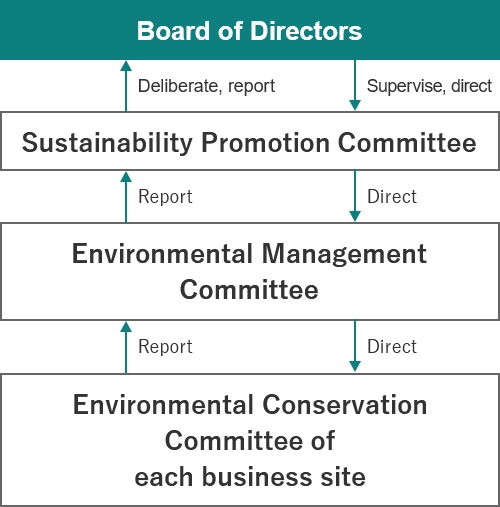
The Group’s environmental conservation promotion system is led by the Environmental Conservation Promotion Committee, a subcommittee of the Sustainability Promotion Committee, and the Environmental Conservation Committees of each business site, and is to promote environmental preservation activities of our Group.

The Environmental Conservation Promotion Committee sets up an Environmental Conservation Promotion Plan based on the roadmap established for achieving Sustainable Vision, and follows up including the progress of the plan. In addition, the Committee receives reports on the results of environmental audits conducted by the Sustainability Promotion Department, and provides instructions and guidance.

Environmental Conservation Promotion Committee

The Environmental Conservation Promotion Committee sets up the Kanadevia Group's Environmental Conservation Promotion Plan based on the roadmap established for achieving Sustainable Vision, and follows up including the progress of the plan. In addition, the Committee receives reports on the results of environmental audits conducted by the Sustainability Promotion Department, and provides instructions and guidance.

Main Discussions on the Environmental Conservation Promotion Committee ( the fiscal year ended March 31, 2024)

The 34th (September 1, 2023)
・Annual reported on environmental data (FY2022)
The 35th (October 30, 2023)
・Implementation status of “Environmental Audits” based on FY2022 results
The 36th (March 1, 2024)
・Revision of company regulations regarding the promotion of environmental preservation

Subsidiary Management in our Group

In principle, the Environmental Management System of Kanadevia Group covers its consolidated subsidiaries, including overseas Group companies. The business formats of Group companies include those with manufacturing facilities, those primarily engaged in engineering and field construction, and those with only offices and no manufacturing facilities. To ensure compliance with environmental laws and regulations, prevent environmental risks from materializing, and promote environmental preservation activities, we select items to be managed at each applicable business site based on the industry, impact on the environment and ecosystems, and other factors, and collect environmental information. In addition, we include subsidiaries that have manufacturing facilities in the scope of surveys and environmental audits conducted by the Sustainability Promotion Department.

ISO Certification Status

The ISO 14001 certification status of our Group is as follows.

  FY2021 FY2022
Japan 9 8
Outside of Japan 3
(including one equity method affiliate)
3
(including one equity method affiliate)
Note 1: Includes companies that acquired certification for only some business sites.
Note 2: Decrease of one company in FY2022 due to the removal of Nippon Pusnes Co., Ltd. from the scope of consolidation.
Note 3: Includes one company in Japan that has acquired a standard equivalent to ISO 14001 (Kyoto Environmental Management System Standard).
Note 4: Coverage rate is 62% in FY2022 (based on consolidated sales)

Environmental Risk Management

As the Group operates in countries and regions around the world, it is essential to manage risks comprehensively, incorporating changes in social conditions and business models. In order to identify and manage the environmental risks of our operations, we and our subsidiaries with significant environmental impacts promote Environmental Management by establishing Environmental Management Systems in accordance with ISO 14001 or other international guidelines on environmental considerations. We have a system in place to promptly report any event that violates environment-related laws and regulations. Due diligence is important when entering, expanding, or exiting a new business. In the future, we will introduce a system of environmental and human rights due diligence to determine the significance of risks based on quantitative and qualitative criteria, and establish a system to determine whether to promote or not and how to respond to such risks in deliberations by the Board of Directors and the Management Committee and in decisions by the Representative Directors.

Initiatives

Environmental law and regulation compliance

There were no environment-related regulatory violations reported in the fiscal year ended March 31, 2023. In addition, we have not received any significant fines or other non-monetary sanctions for violations of environmental laws and regulations.
We also received two complaints from neighbors about noise from the plant. All of these issues have been resolved through corrective actions and recurrence prevention measures.
There was one reported violation of environmental laws and regulations in the fiscal year ended March 31, 2024. We promptly analyzed and identified the cause, took emergency and permanent measures, and submitted an improvement report.

Environmental communication

We promote activities to educate and raise awareness about the environment, such as by hosting tours of Waste to Energy (WtE) plants and biomass power plants that we have built, and by offering lectures at elementary schools in local communities in the fiscal year ended March 31, 2023.
In the fiscal year ended March 31, 2024, we continued to promote activities that lead to environmental education and awareness, and for the fourth consecutive year we held a tour of the Miyanosato Woody Biomass Power Plant.
In addition, we have been involved in environmental awareness activities in Laos since 2015. From 2021 to 2024, we are conducting a technical exchange program with the National University of Laos that includes environmental awareness education on waste management. During the period under review, we introduced the business process and issues that led to the creation of our WtE plant, and discussed with the students the challenges that Laos faces and what the country should be like in the future, deepening their understanding.

Environment-related training

In FY2023, as part of the Sustainability Promotion Project, we held a lecture on the essence of Sustainable Management.
For more information, please see “Spreading Sustainable Management".
We are also working to acquire specialized knowledge, such as training ISO 14001 auditors.